Tuesday, March 15, 2011

[ALERT] Core meltdown at Fukushima Dai'ichi highly likely

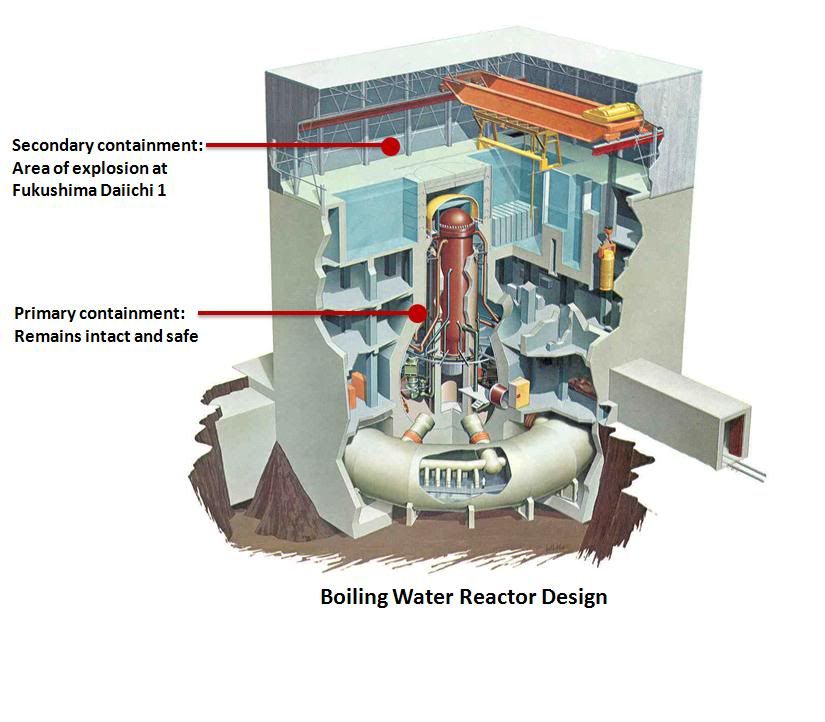
There is some good reporting on the state of the containment efforts at the out-of-control nuclear fission reaction housed in the Fukushima I Nuclear Power Plant. The New York Times has a lengthy article. There is an excellent description, of a moderately technical nature, on the Beyond Nuclear website. And a lot more that you can find among the noise.

There is a little gold-mine of an interview of a nuclear engineer (done by his daughter). [Video/audio/transcript available.]

The short version is this: a skeleton staff of personnel of about 60 people at the Fukushima I Nuclear Power Plant stands a very low probability of averting a meltdown. From the Times article:
“We are on the brink,” said Hiroaki Koide, a senior reactor engineering specialist at the Research Reactor Institute of Kyoto University. “We are now facing the worst-case scenario. We can assume that the containment vessel at Reactor No. 2 is already breached. If there is heavy melting inside the reactor, large amounts of radiation will most definitely be released.”

Thursday, April 8, 2010

[Short entry] News "analysis" NY Times style

NY Times staff writers David Sanger and Thom Shanker graced us a couple of days ago with some chicken-little one-liners in Obama’s Nuclear Strategy Intended as a Message.

There are too many speculative gaffs in this article to take it very seriously. They opine: "Mr. Obama’s new strategy makes just about every nonnuclear state immune from any threat of nuclear retaliation by the United States." Unless, of course, the unlikely scenario occurs that a country -- their leadership or population -- does something that the Obama administration doesn't like. Then we'll group them with the "outliers", N. Korea and Iran and then we can continue to threaten them with annihilation.

As far as the stated policy objective of Obama's "new" nuclear doctrine is concerned, even Sanger and Shanker appear to agree with Lindsay and Takeyh writing for Foreign Affairs who have concluded that a nuclear-armed Iran poses little by way of existential threat to the US (though they lament the difficulties in getting Iran to 'go along' with US interests in the region).

Simple errors of logic aside, Sanger and Shanker really hurl into the abyss down toward the bottom of the article:
If a backpack nuclear bomb went off in Times Square or on the Mall in Washington, the Pentagon and the Department of Energy would race to find the nuclear DNA of the weapon — so that the country that was the source of the material could be punished. But the science of “nuclear attribution” is still sketchy. And without certain attribution, it is hard to seriously threaten retaliation.
Hard to believe you can get so much chicken-little thinking into one sentence. Each syllable of this sort of screed should be weighed by the reader. First -- there is no known nuclear device that can fit in a backpack (I think Sanger and Shanker watch too much Lost). "Nuclear attribution" is far from its state-of-the-art development. But calling it "sketchy" is just wrong. Nuclear material is well tracked and the properties of known fissile materials, from all the nuclear nations, are recorded in detail. Attribution is almost certain given the detonation forensics and human intelligence, which is very good on issues related to nuclear material.

The article is essentially fantasy and the Obama nuclear doctrine is the latest in a series of "might equals right" diplomacy.

It's only disappointing if you expected any leadership from Obama.

Tuesday, April 6, 2010

[Short entry] NYT: Obama Limits When U.S. Would Use Nuclear Arms

Much ado about not so much again, in today's Times. The article roll-out contends that "change," in the form of "limits," is afoot. But in the second paragraph the other shoe drops (usually we have to wait for the last two or three paragraphs in Sanger and/or Baker articles for this denouement). There we find out that "outliers" like Iran and N. Korea -- the only countries who have declared that the best reason they have to seek a nuclear weapons program is because of their fear that the U.S. may attack* -- are excluded from the new "approach."

*Addition: See the report "Situation in the Korean Peninsula -- a North Korean perspective" available via the CSIS website. The first paragraph at the top of the second page of the report:
The DPRK made nuclear weapons and has strengthened its self-defensive war deterrent to maintain the sovereignty and the right to existence of the nation in the face of the increased aggressive threat by the U.S.
Earlier in this article, we find the motivation for using the term "aggressive threat:"
Second, tensions are the result of all kinds of military
exercises and arms reinforcement conducted by the U.S. on the
Korean peninsula. No sooner had the U.S. Administration
taken power than it conducted the unprecedented large-scale
joint military exercises “Key Resolve” and “Foal Eagle” in
and around south Korea in March and thus severely threatened
the security of the DPRK. These were nuclear war exercises
for the preemptive attack on the DPRK entirely in its scale as
well as its contents. This is well known through the fact that a
larger number of U.S. forces than in the past and attackable
military equipment including two aircraft carriers and nuclear
submarines were thrown in the joint military exercises and the
period of exercises was doubled.

Now, these are certainly exaggerated claims, in tenor if not in substance. But the fact remains: the U.S. military presence on the Korean peninsula is taken as a threat. Is it necessary to carry out foreign policy in this manner?

Wednesday, March 17, 2010

[Short entry] Iran's nuclear weapons program

The shortness of the article in the NYT probably wasn't the reason that there was no discussion of the foregone conclusion on the part of "the respectable" and "the elite" including Elisabeth Bumiller of the NYT, that "still remained the greatest threat to stability in the Middle East and Central Asia." This claim is rarely, if ever, analyzed in the "Papers of Record."

Interestingly enough, if you poll people in the M.E. and Central Asia -- and this has been done extensively -- the greatest perceived threat to stability is the U.S. military, next to Israel and population growth. Of course, for the NYT David Patreus' opinion deserves particular attention.

Related information:
America: the greatest threat to global stability
Muslim Publics Oppose Al Qaeda's Terrorism, But Agree With Its Goal of Driving US Forces Out
Pakistanis see US as greatest threat
Occupation and foreign military intervention 'greatest threat'

Monday, March 15, 2010

[Short entry] Proliferation of nuclear technology

Items of concern in today's NYT's article Taking a Risk With Nuclear Technology other then the obvious risks associated with proliferation of a power source which generates tons of waste, which cannot be disposed of for generations (isolation isn't disposal) include the issue related to "passive controls" that the Westinghouse reactors employ. These are control mechanisms usually associated with individual components of a reactor which respond without intervention from an electronic monitoring system and without intervention from a human operator. The response, obviously, of the component to an system imbalance which could tend to emergency is to reduce the possibility of that emergency. For example, a pressure-relief valve is a type of passive system. It requires no input from external control systems (electronic, human, or otherwise) to work. It simply responds in a threat-reduction manner by "the laws of physics."

There are several dangers associated with this notion. The most pronounced are based on the assumptions humans make in determining the behavior of the passive control. If the component, say the pressure-relief valve is faulty, "the laws of physics" will result in a different behavior of the valve.

Passive controls are also dangerous psychologically and socially because people (nuclear engineers, in particular) have been trained to believe that responses are likely to happen in certain ways. "Margin of error" factors are used to account for this, but these are only statistical measures.

Do you want finite, even if small, probabilities for a meltdown at the local reactor?

Friday, March 12, 2010

Chomsky on Iranian deterrent [weblog Op-Ed entry]

Noam Chomsky spoke at Harvard Memorial Church on March 6. His analysis, largely supported by the public record, is that the constant threat of force by the U.S. is driving the Iranians to develop a nuclear weapons deterrent. Paraphrasing, "They'd be crazy not to."

There is very good historical parallels with North Korea to support Chomsky's analysis. The U.S. "talked tough" on N. Korea and marginalized its leadership, keeping "all options on the table" through the last 60 years of administrations. They offered unilateral talks continually to address the threat the U.S. posed to their sovereignty, all summarily denied. They offered to sign non-proliferation treaties, which the U.S. ignored.

Now they have a burgeoning weapons program.

Contrast the situation with Iraq who had no substantive nuclear weapons program at any point in their history. The U.S. has decimated that country with violence.

What's the lesson?

Yucca Mountain waste repository project closed

In a significant development, which drastically changes the terrain of the renewed nuclear power and waste isolation the Department of Energy has withdrawn its license application with the Nuclear Regulatory Commission. This effectively ends the project and begs the question: what, where, when, who and most importantly, why now?

Let's remind ourselves of the basics of how we generate electrical power from uranium. The basic principle is that since uranium decays radioactively -- it's "hot" -- the energy given off by the components of the decaying nuclei can be used to heat water into steam. That steam is then used to drive a turbine, which is connected to a electrical generator.

So let's look at the life cycle of a chunk of uranium. In the previous post, February 19, 2010, we discussed how uranium is isolated from dirt and rock in naturally occurring deposits called uraninite or, commonly, pitchblende. After processing the ore to natural uranium, chemical and/or mechanical processing is needed to purify or enrich the material to isolate the desirable component 235U. (You might recall the role of warehouse-sized fields of centrifuges.) Keep in mind that, when determining the economic feasibility of nuclear power, we need to take into account the cost of all the stages of production, consumption, and isolation of the radioactive material.

Now, once we've isolated the 235U (read "U-235" or "235-U," either way) to low-enriched (anywhere from 4% to 20%) we can think about putting this "hot," radioactive material into a reactor and use it to make electricity to run our mechanized world. The form in which the enriched uranium goes in to the reactor is as nuclear fuel, often shaped in cylinders (which themselves are comprised of fuel pellets) commonly referred to as rods. The rods are placed into the reactor core, in various configurations depending on the reactor, and water under pressure is circulated throughout the chamber, called the reactor core, which removes the heat of the nuclear reaction. There's no mixing of the nuclear fuel with water.

After a period of time, typically on the order of weeks or months, the nuclear fuel is "spent" in the process of the decay of the 235 nuclei which comprise the material. (We'll talk about the quantum mechanics of the process of radioactive decay in the next entry. Promise.) Spent nuclear fuel is also known as waste. Waste is an interesting concept that humans have come up with stuff that we've stopped thinking about. But if you stop thinking about this waste, you're going to get into some trouble.

Dealing with the spent nuclear fuel is -- by far -- the most costly part of generating electricity from radioactive materials. You can't throw it away. It must be isolated. This is where the Yucca Mountain waste repository project came into play. The problem is that the spent nuclear fuel is still hot, literally. While the fuel is "spent" as far as the reactor engineer is concerned (because it has become contaminated with the products of the radioactive element and its activity has fallen below design specification) it's ain't so for us. This stuff is nasty. Still radioactive and toxic to boot. And it remains active for a long time.

So the question is what do you do with it so that it's isolated from flora and fauna (include people in this category, why not?) and doesn't do all the bad things that radiation poisoning can do. (Another topic for a future entry!)

There have been a lot of ideas on how to isolate spent nuclear fuel. All of them are ludicrous. Most of them are economically unfeasible. "Send it to 'outer' space."Or 'the moon.' Forget about giving it to NASA. It's too expensive and what if the Challenger had been loaded up with this junk?

The only idea that's considered feasible economically is burial. Stick it into the ground in a deep hole. And hope. I say "considered" feasible because it's not -- really.

The first problem is the cost of building, storing, maintaining, monitoring, and preventing accidental release of the spent material. If anything goes wrong on a large scale -- water contamination, fire, earthquake, etc. -- we're up you-know-where without a you-know-what. You can't easily "handle" this stuff, after all.

Yucca Mountain was selected by Congress[!!], not by scientific process of elimination, but for overtly political considerations. They said "it's dry enough." Turns out it's not. If water gets near this stuff, usually held in metal barrels the show is over.

More later about the details of the actual storage of spent nuclear fuel.