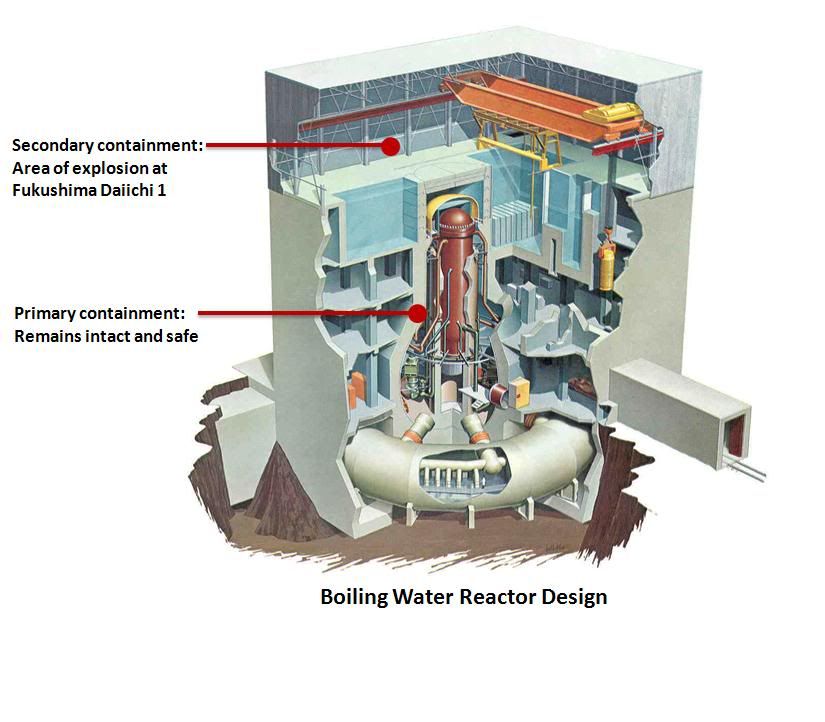
What the New York Times calls "at least a partial meltdown" has occurred at the Fukushima I nuclear power plant's reactor 3. The fact that plutonium has been found in the soil outside this reactor is conclusive evidence that the steel core containment vessel has been breached. The cause of this compromise of the containment vessel and building is the consequence of excessive heat generated by the ongoing nuclear reactions inside the core -- in short, a "meltdown" has occurred.
This is a catastrophe of this highest order -- it really doesn't get much worse than this in the nuclear industry. And the area will be unaccessible and uninhabitable for many decades.
More reporting from ABC.
Tuesday, March 29, 2011

Wednesday, March 16, 2011
[ALERT] Nuclear Event Scale goes to 6 out of 7
• Fears of a catastrophe at the Fukushima nuclear power plant in Japan escalated following a third explosion and a fire in another reactor that caused radiation to rise to harmful levels.
France's ASN nuclear safety authority says the nuclear accident at the Fukushima Daiichi plant could now be classed as level six out of the International Nuclear Event Scale of one to seven.
Guardian link
France's ASN nuclear safety authority says the nuclear accident at the Fukushima Daiichi plant could now be classed as level six out of the International Nuclear Event Scale of one to seven.
Guardian link
Tuesday, March 15, 2011
[ALERT] US expert: Breach possible at Japan nuclear plant
Associated Press
US expert: Breach possible at Japan nuclear plant
Associated Press, 03.15.11, 11:17 AM EDTWASHINGTON -- A U.S. nuclear industry official says there is evidence that the primary containment structure at one of the stricken Japanese reactors has been breached, raising the risk of further release of radioactive material.
Anthony Pietrangelo of the Nuclear Energy Institute said Tuesday that falling pressure inside the suppression pool at the No. 2 reactor at Fukushima Dai-ichi and reports of rising radiation levels there raise the possibility that the reactor's containment has been breached. He said the breach of the primary containment structure could lead to the release of more radioactive materials.
Pietrangelo, chief nuclear officer of the institute, also praised Japanese authorities, saying that they were doing a "heroic" job of dealing with the damage to several nuclear plants in the wake of last week's earthquake and tsunami.
Copyright 2011 The Associated Press. All rights reserved. This material may not be published, broadcast, rewritten or redistributed.
[ALERT] Core meltdown at Fukushima Dai'ichi highly likely
There is some good reporting on the state of the containment efforts at the out-of-control nuclear fission reaction housed in the Fukushima I Nuclear Power Plant. The New York Times has a lengthy article. There is an excellent description, of a moderately technical nature, on the Beyond Nuclear website. And a lot more that you can find among the noise.
There is a little gold-mine of an interview of a nuclear engineer (done by his daughter). [Video/audio/transcript available.]
The short version is this: a skeleton staff of personnel of about 60 people at the Fukushima I Nuclear Power Plant stands a very low probability of averting a meltdown. From the Times article:
There is a little gold-mine of an interview of a nuclear engineer (done by his daughter). [Video/audio/transcript available.]
The short version is this: a skeleton staff of personnel of about 60 people at the Fukushima I Nuclear Power Plant stands a very low probability of averting a meltdown. From the Times article:
“We are on the brink,” said Hiroaki Koide, a senior reactor engineering specialist at the Research Reactor Institute of Kyoto University. “We are now facing the worst-case scenario. We can assume that the containment vessel at Reactor No. 2 is already breached. If there is heavy melting inside the reactor, large amounts of radiation will most definitely be released.”
Thursday, April 8, 2010
[Short entry] News "analysis" NY Times style
NY Times staff writers David Sanger and Thom Shanker graced us a couple of days ago with some chicken-little one-liners in Obama’s Nuclear Strategy Intended as a Message.
There are too many speculative gaffs in this article to take it very seriously. They opine: "Mr. Obama’s new strategy makes just about every nonnuclear state immune from any threat of nuclear retaliation by the United States." Unless, of course, the unlikely scenario occurs that a country -- their leadership or population -- does something that the Obama administration doesn't like. Then we'll group them with the "outliers", N. Korea and Iran and then we can continue to threaten them with annihilation.
As far as the stated policy objective of Obama's "new" nuclear doctrine is concerned, even Sanger and Shanker appear to agree with Lindsay and Takeyh writing for Foreign Affairs who have concluded that a nuclear-armed Iran poses little by way of existential threat to the US (though they lament the difficulties in getting Iran to 'go along' with US interests in the region).
Simple errors of logic aside, Sanger and Shanker really hurl into the abyss down toward the bottom of the article:
The article is essentially fantasy and the Obama nuclear doctrine is the latest in a series of "might equals right" diplomacy.
It's only disappointing if you expected any leadership from Obama.
There are too many speculative gaffs in this article to take it very seriously. They opine: "Mr. Obama’s new strategy makes just about every nonnuclear state immune from any threat of nuclear retaliation by the United States." Unless, of course, the unlikely scenario occurs that a country -- their leadership or population -- does something that the Obama administration doesn't like. Then we'll group them with the "outliers", N. Korea and Iran and then we can continue to threaten them with annihilation.
As far as the stated policy objective of Obama's "new" nuclear doctrine is concerned, even Sanger and Shanker appear to agree with Lindsay and Takeyh writing for Foreign Affairs who have concluded that a nuclear-armed Iran poses little by way of existential threat to the US (though they lament the difficulties in getting Iran to 'go along' with US interests in the region).
Simple errors of logic aside, Sanger and Shanker really hurl into the abyss down toward the bottom of the article:
If a backpack nuclear bomb went off in Times Square or on the Mall in Washington, the Pentagon and the Department of Energy would race to find the nuclear DNA of the weapon — so that the country that was the source of the material could be punished. But the science of “nuclear attribution” is still sketchy. And without certain attribution, it is hard to seriously threaten retaliation.Hard to believe you can get so much chicken-little thinking into one sentence. Each syllable of this sort of screed should be weighed by the reader. First -- there is no known nuclear device that can fit in a backpack (I think Sanger and Shanker watch too much Lost). "Nuclear attribution" is far from its state-of-the-art development. But calling it "sketchy" is just wrong. Nuclear material is well tracked and the properties of known fissile materials, from all the nuclear nations, are recorded in detail. Attribution is almost certain given the detonation forensics and human intelligence, which is very good on issues related to nuclear material.
The article is essentially fantasy and the Obama nuclear doctrine is the latest in a series of "might equals right" diplomacy.
It's only disappointing if you expected any leadership from Obama.
Tuesday, April 6, 2010
[Short entry] NYT: Obama Limits When U.S. Would Use Nuclear Arms
Much ado about not so much again, in today's Times. The article roll-out contends that "change," in the form of "limits," is afoot. But in the second paragraph the other shoe drops (usually we have to wait for the last two or three paragraphs in Sanger and/or Baker articles for this denouement). There we find out that "outliers" like Iran and N. Korea -- the only countries who have declared that the best reason they have to seek a nuclear weapons program is because of their fear that the U.S. may attack* -- are excluded from the new "approach."
*Addition: See the report "Situation in the Korean Peninsula -- a North Korean perspective" available via the CSIS website. The first paragraph at the top of the second page of the report:
Now, these are certainly exaggerated claims, in tenor if not in substance. But the fact remains: the U.S. military presence on the Korean peninsula is taken as a threat. Is it necessary to carry out foreign policy in this manner?
*Addition: See the report "Situation in the Korean Peninsula -- a North Korean perspective" available via the CSIS website. The first paragraph at the top of the second page of the report:
The DPRK made nuclear weapons and has strengthened its self-defensive war deterrent to maintain the sovereignty and the right to existence of the nation in the face of the increased aggressive threat by the U.S.Earlier in this article, we find the motivation for using the term "aggressive threat:"
Second, tensions are the result of all kinds of military
exercises and arms reinforcement conducted by the U.S. on the
Korean peninsula. No sooner had the U.S. Administration
taken power than it conducted the unprecedented large-scale
joint military exercises “Key Resolve” and “Foal Eagle” in
and around south Korea in March and thus severely threatened
the security of the DPRK. These were nuclear war exercises
for the preemptive attack on the DPRK entirely in its scale as
well as its contents. This is well known through the fact that a
larger number of U.S. forces than in the past and attackable
military equipment including two aircraft carriers and nuclear
submarines were thrown in the joint military exercises and the
period of exercises was doubled.
Now, these are certainly exaggerated claims, in tenor if not in substance. But the fact remains: the U.S. military presence on the Korean peninsula is taken as a threat. Is it necessary to carry out foreign policy in this manner?
Wednesday, March 17, 2010
[Short entry] Iran's nuclear weapons program
The shortness of the article in the NYT probably wasn't the reason that there was no discussion of the foregone conclusion on the part of "the respectable" and "the elite" including Elisabeth Bumiller of the NYT, that "still remained the greatest threat to stability in the Middle East and Central Asia." This claim is rarely, if ever, analyzed in the "Papers of Record."
Interestingly enough, if you poll people in the M.E. and Central Asia -- and this has been done extensively -- the greatest perceived threat to stability is the U.S. military, next to Israel and population growth. Of course, for the NYT David Patreus' opinion deserves particular attention.
Related information:
America: the greatest threat to global stability
Muslim Publics Oppose Al Qaeda's Terrorism, But Agree With Its Goal of Driving US Forces Out
Pakistanis see US as greatest threat
Occupation and foreign military intervention 'greatest threat'
Interestingly enough, if you poll people in the M.E. and Central Asia -- and this has been done extensively -- the greatest perceived threat to stability is the U.S. military, next to Israel and population growth. Of course, for the NYT David Patreus' opinion deserves particular attention.
Related information:
America: the greatest threat to global stability
Muslim Publics Oppose Al Qaeda's Terrorism, But Agree With Its Goal of Driving US Forces Out
Pakistanis see US as greatest threat
Occupation and foreign military intervention 'greatest threat'
Subscribe to:
Comments (Atom)